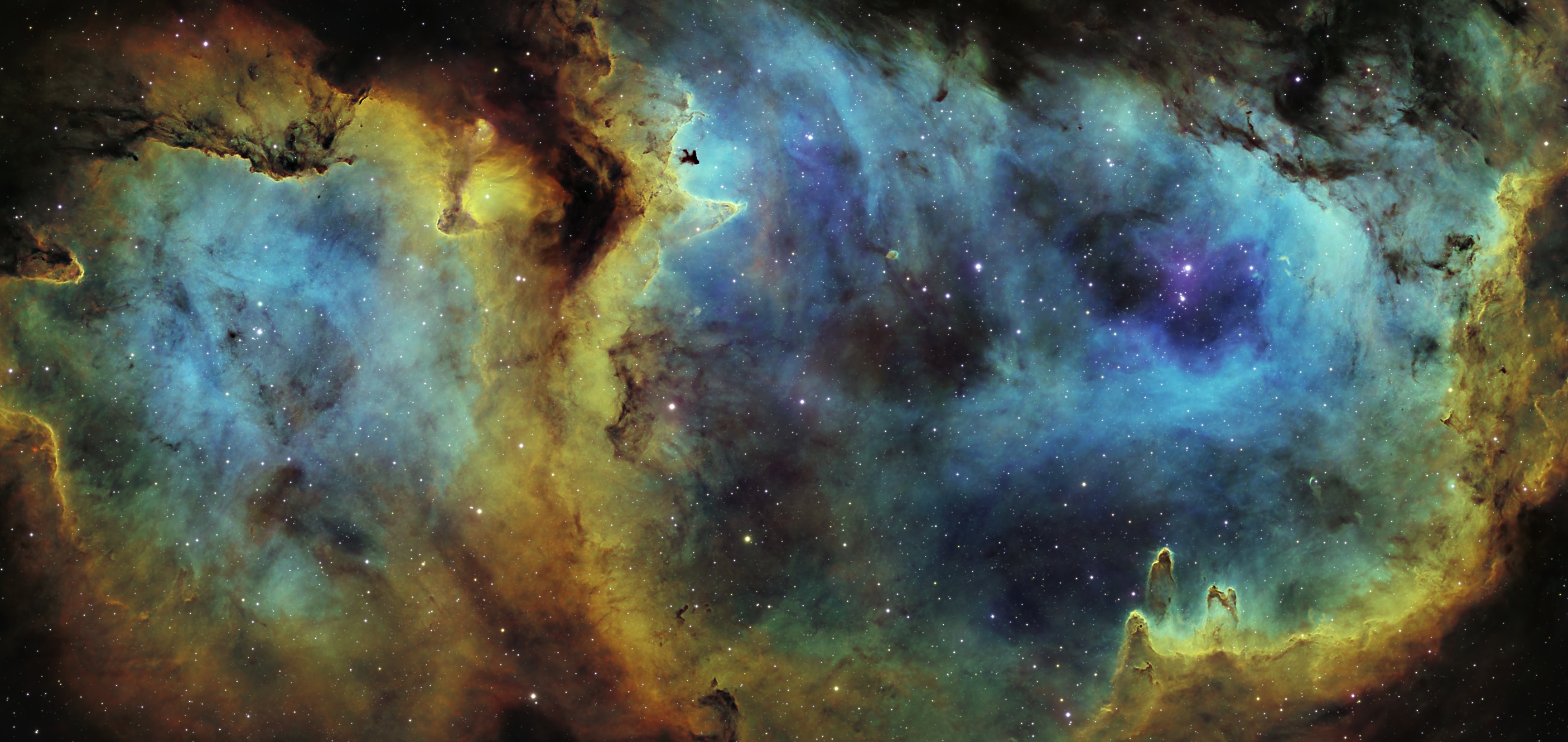
Soul Nebula (IC 1848) - SHO
Emission nebula in Cassiopeia, companion to the Heart Nebula, in SHO narrowband
Click to explore in full resolution
Technical Specifications
Resolution: 2811x1330
Integration: SHO narrowband (Ha/OIII/SII)
Captured: Backyard capture
Equipment: Redcat71 refractor (350mm) with ZWO ASI2600MM Pro camera on Advanced VX mount
Location: Backyard location
Processing Workflow
Scientific Context
The Soul Nebula (IC 1848), also cataloged as Sharpless 2-199 and Westerhout 5, is a large emission nebula located approximately 6,500 light-years away in the constellation Cassiopeia. It sits right beside its famous companion, the Heart Nebula (IC 1805), and together the pair are often referred to as the "Heart and Soul."
The nebula is a vast star-forming region energized by the radiation and stellar winds of a young open cluster of massive stars embedded within it. These hot, luminous stars carve out cavities and sculpt the surrounding hydrogen gas into towering pillars and dense globules, several of which are visible silhouetted against the glowing background.
This image was captured using the SHO (Sulfur-Hydrogen-Oxygen) narrowband technique, mapping the emission from ionized sulfur, hydrogen, and oxygen to the red, green, and blue channels respectively. The resulting palette - popularized by the Hubble Space Telescope - separates the different ionized gases by color, revealing the intricate structure of the nebula's shock fronts, dust lanes, and ionization boundaries even from light-polluted skies.
Spanning roughly 2 degrees across the sky, the Soul Nebula is an active stellar nursery where new stars continue to form within its dense clouds of gas and dust.